

Moving House in a Western Sydney Heatwave: Start Early and Keep the Essentials Out of the Truck
Plan a summer move in Western Sydney as an early start, check the Bureau of Meteorology's heatwave forecast in the week before, carry medicines, documents and cold water in your own air-conditioned car rather than the truck, and never leave a pet in a parked car.
How often is it 30°C or hotter in Western Sydney?
If you pick a moving day between November and February, the odds are roughly two in five that it reaches 30°C in north-west Sydney. That is our estimate, and here is the working.
The Bureau of Meteorology's Richmond RAAF climate statistics give a mean of 8.5 days at 30°C or above in November, 13.2 in December, 15.3 in January and 11.9 in February. Those add to about 49 days out of the 120 in those four months, or about 41%. The same table gives 2.9, 4.5, 6.1 and 3.4 days at 35°C or above, which adds to about 17 days, close to one in seven.
January is the peak. It averages a 30.4°C maximum, and about half its days reach 30°C, according to the same BoM table. Early summer can be extreme too. Richmond's November record is 45.3°C, set on 23 November 2014, and its all-time high is 47.4°C on 4 January 2020 (BoM Richmond RAAF). These figures come from the Bureau's Richmond RAAF station, so read them as north-west Sydney figures rather than a Blacktown reading.
This season looks hotter than those averages. The BoM climate outlook issued on 29 October 2026 says daytime maximums from November to January are very likely, at greater than an 80% chance, to be above average across almost all of Australia. It puts the chance of unusually high maximums at over 70% across eastern, southern and western NSW. The same outlook notes that a strong El Niño is underway and expected to peak around November and December. BoM also says a strong El Niño signal does not necessarily mean strong impacts on Australia's temperature.
What counts as a heatwave, and when will you know?
7 days out: BoM forecasts heatwaves likely in the next 7 days.
Up to 4 days out: BoM warnings for severe or extreme heatwaves.
Every day: Warnings issued 3pm local time, shown on the BoM Weather app.
Heatwave = unusually hot maximum AND minimum temperatures over 3 days, compared with the local climate.
A heatwave is not just one hot day: the Bureau measures three days of day and night temperatures against what is normal for the place and the past 30 days (BoM, What is a heatwave). The nights matter for a move. Hot nights make it harder for the body to recover, so a crew and a family who sleep badly on night two start day three already behind.
BoM grades heatwaves as low-intensity, severe or extreme. Severe ones are harder on vulnerable people. In extreme ones even healthy people are at risk, and "anyone who works or exercises outdoors can be at risk". A moving day is outdoor work for everyone carrying boxes.
The warning lead time is short, so know where to look:
- BoM's heatwave service forecasts heatwaves likely in the next 7 days and warns of severe or extreme heatwaves up to 4 days ahead.
- Warnings are issued at 3pm local time and appear on the BoM Weather app.
- Warnings are generally issued from October to the end of March, and NSW Health can issue a heat alert at any time if early-season hot weather is forecast.
- Early summer is a trap. BoM says it takes higher temperatures to meet heatwave criteria late in summer than early in the season, and a sharp rise after a cool spell shows up in the forecast. That means a November move can land in a heatwave at temperatures that would not count as one in February (our reading of the BoM wording).
The early-start plan for moving house in hot weather
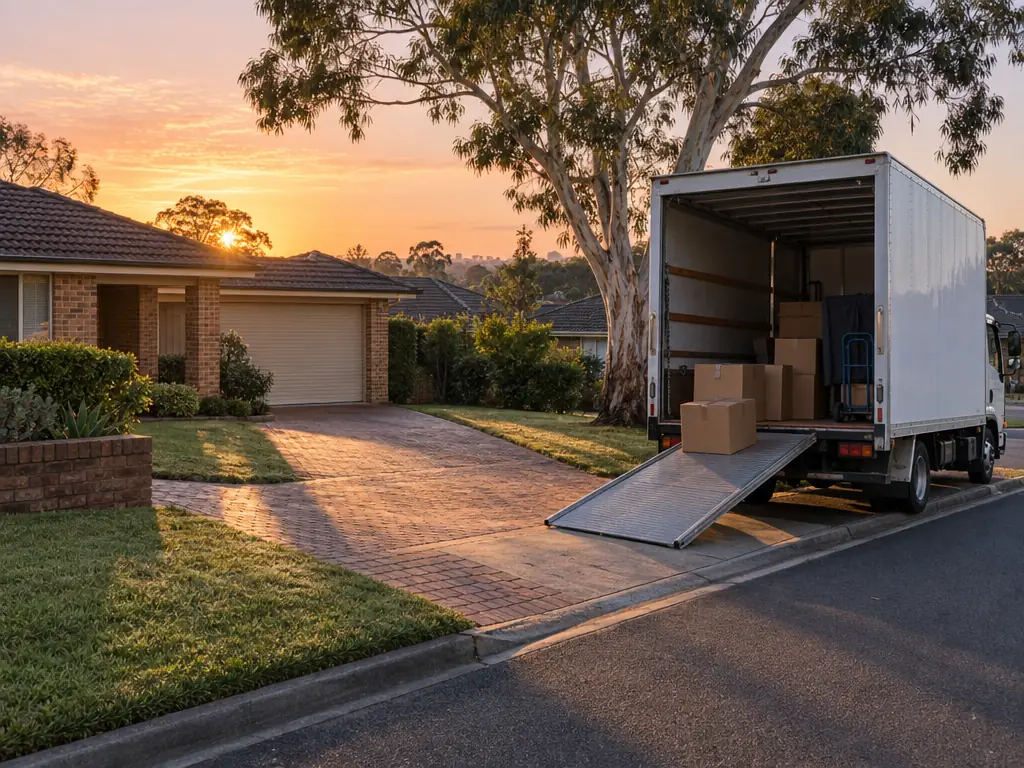
The plan is simple: start at first light and get the heavy lifting done before the afternoon. SafeWork NSW's guide for workplaces says to schedule outdoor work for early morning or late afternoon. It is written for employers, but it is a sensible benchmark for anyone carrying a couch down a driveway. Our daylight saving moving guide covers how the clocks and first light shape that early start.
Around the start, build in four habits:
- Book early for December to February. Hot days cluster there: January alone averages 15.3 days at 30°C or above at Richmond.
- Check the 7-day heatwave forecast the week before, then the 4-day warning window.
- Keep a fallback date, the way you would for rain. If your move hangs on a settlement, our settlement-day planner helps you see how much room you have.
- Ask your removalist, at quote time, how they handle a day under a severe or extreme heatwave warning. That applies to Sunnyholt Removals and to anyone else you are comparing. Get the answer alongside the quote, as our guide to choosing a removalist suggests for every other term.
What not to leave in the truck
In your air-conditioned car
- Medicines (most need below 25°C); EpiPens, inhalers, autoinjectors: never in a hot car or direct sun
- Documents and valuables
- Things you need on arrival
- Cooler box with ice and water
- Pets travel with you, never left in a parked car
In the truck
- Furniture and packed boxes
- Fridge emptied of food
Check first
- Gas BBQ cylinders: purge certificate
- Pool chemicals
- Fuel-containing garden equipment
- Fire extinguishers
- Plants: may need a certificate
- Aerosol cans: don't pack
- Appliances: manufacturer's instructions
Some things should ride in the cabin of your own air-conditioned car, with you. Neither the truck nor a parked car is the place for them.
Medicines. Most medications need to be stored below 25°C, and the Pharmaceutical Society's journal warns that leaving them in a car for a short time in direct sun could be problematic. EpiPens, inhalers and autoinjectors must not be left in hot cars or direct sun, because heat can make them malfunction and inhalers can burst. Before the move, ask your doctor or pharmacist whether your medicines need the fridge, or become less effective or toxic in severe heat. After it, look for changes in colour, consistency or smell, softening or melting, and cracked coatings.
Documents, valuables and the first-day box. AFRA's moving do's and don'ts say to carry the items you need on arrival in your own car and keep valuables and documents with you.
Cold water and ice. The NSW Government's heatwave advice is to keep ice and a cooler box ready. On moving day that cooler is your drinks station while the kitchen is in boxes.
The fridge, emptied. AFRA says don't leave food in the fridge and check the manufacturer's instructions before moving appliances. Follow your own model's manual on how long to wait before switching it back on.
The check-first list. AFRA lists gas BBQ cylinders, pool chemicals, fuel-containing garden equipment, fire extinguishers, plants and animals as items needing special attention or ineligible. BBQ cylinders need a purge certificate, and plants may need a certificate. Don't pack aerosol cans. If you own anything you suspect doesn't like heat, ask your removalist how they would load it.
Keeping people and pets well on a hot moving day
| People (SafeWork NSW workplace guide) | Pets (RSPCA NSW) |
|---|---|
Use a buddy system: people past dehydration may not judge their own state well. |
Move the pet to shade or air-conditioning and call a vet. |
Water and rest need a rhythm, not good intentions. SafeWork NSW's guide for workers sets a useful benchmark: a small cup (200 ml) of cool water every 15 to 20 minutes. Use cool water rather than icy water, which can cause stomach cramps. The same guide says to skip energy drinks, coffee, soft drinks and alcohol, and not to take salt tablets. For rest, it suggests a break about every hour in a cooler or shaded place, up to 30 minutes in each hour when the work is hot, humid and heavy.
Pair people up. SafeWork NSW notes that people past dehydration may not judge their own state well, so a buddy watching for the signs in the table above is worth more than anyone saying "I'm fine". Treat any of those signs as the cue to stop and cool down, and get medical advice if you are worried.
Some helpers should carry less, or nothing. SafeWork NSW lists people over 45, pregnant people, people with heart or lung disease, people on certain medications and people not used to working in heat as being at higher risk. Set up one quiet, cool room early, at either end, for kids, older relatives and anyone in that list.
Never leave pets in cars, not even for a quick errand, and not even with the windows down.
Pets need the same room and a firm rule. RSPCA NSW says to never leave pets in cars, "not even with the windows down". Short-faced dogs and cats, rabbits and birds are especially vulnerable. Use the RSPCA's hand test before walking a dog across the driveway: if the pavement is too hot to hold your hand on for five seconds, it is too hot for its paws. If you see heavy panting, drooling, weakness, vomiting or collapse, move the pet to shade or air-conditioning and call a vet. Moving into a rental with a pet? The consent clock starts when you sign the lease, not on move-in day, as our pets-in-rentals guide explains.
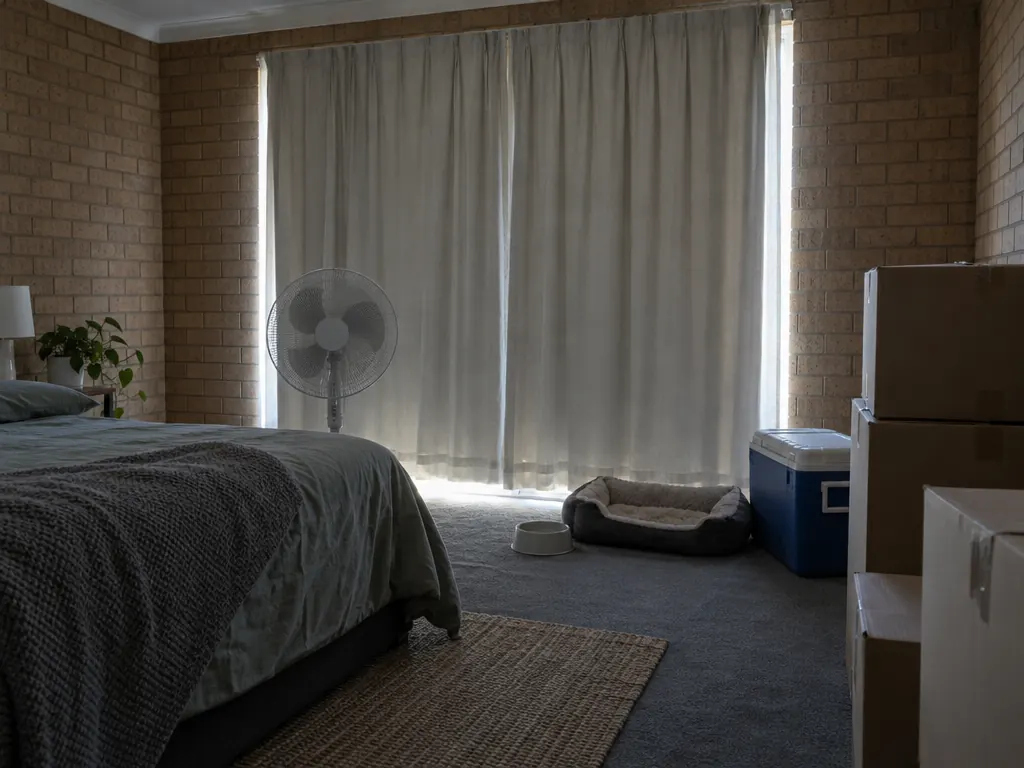
The first night: cooling and power at the new place
Before the truck arrives, or as soon as you have the keys, check that the fridge, freezer, fans and air conditioners work. For the first night, block west-facing windows with pale-lined curtains or reflective coverings. A towel taped over a west window is a fine stopgap while the curtain box is still sealed.
Renters should check the ceiling as well. Only 22% of NSW rental homes have insulation, against 54% of owner-occupied homes, so a rental can hold the afternoon's heat well into the night.
Heatwaves can bring outages. If the power fails, a closed fridge keeps food cold for up to 4 hours and a closed freezer for up to 24 hours. Keep the doors shut and the cooler box handy. Endeavour Energy is the distributor for Sydney's Greater West, so check its website for outage updates, and stay at least 8 m from any fallen powerlines.
The hot-move numbers to keep
- 200 ml of cool water every 15 to 20 minutesSafeWork NSW workplace benchmark
- Rest about every hour; up to 30 minutes in each hour if hot, humid and heavy workSafeWork NSW
- Most medicines: store below 25°CNSW Government
- Closed fridge: cold for up to 4 hours in an outageNSW Government
- Closed freezer: up to 24 hoursNSW Government
- BoM severe or extreme heatwave warnings: up to 4 days aheadBureau of Meteorology
- Too hot for your hand on the pavement for 5 seconds = too hot for a dog's pawsRSPCA NSW
- Fallen powerlines: stay at least 8 m awayNSW Government
Screenshot this panel for moving week. Each figure comes from the source named beside it, and the water and rest rhythm is a workplace benchmark rather than a rule for households.
Planning a summer move with Sunnyholt Removals
If your move falls between now and February, the most useful thing you can do this week is lock in an early start and name a fallback date. When you ask Sunnyholt Removals for a quote, give us both dates and ask how we would plan around a heatwave warning. Then pack the car list first, so the medicines, papers and cooler are sorted before the first box goes on the truck.
Sources
- https://www.bom.gov.au/climate/averages/tables/cw_067105_All.shtml
- https://www.bom.gov.au/climate/ahead/outlooks/archive/20261029-outlook.shtml
- https://www.bom.gov.au/resources/learn-and-explore/heatwave-knowledge-centre/what-is-a-heatwave
- https://www.bom.gov.au/resources/learn-and-explore/heatwave-knowledge-centre/heatwave-services
- https://www.nsw.gov.au/emergency/heatwaves/understand-your-risk
- https://www.nsw.gov.au/emergency/heatwaves/power-outages
- https://www.nsw.gov.au/emergency/heatwaves/prepare-your-household
- https://www.safework.nsw.gov.au/resource-library/heat-and-environment/working-in-extreme-heat-the-facts
- https://www.australianpharmacist.com.au/maintaining-medicine-integrity-in-high-temperatures/
- https://www.rspcansw.org.au/animal-care-information/keeping-pets-safe-in-the-heat-essential-tips-for-pet-owners/
- https://afra.com.au/moving/moving-tips/ineligible-items/
- https://afra.com.au/moving/moving-tips/moving-dos-and-donts/
- https://www.energy.nsw.gov.au/nsw-plans-and-progress/regulation-and-policy/public-consultations/meers
Pictures in this guide are illustrations, not photos of our jobs.